The Godman was
dressed in a suit, had round glasses and flaming eyes. He ran on a high down
the lines of people waiting for different routes of bus 129. I was waiting for
the highway bus because it was the quickest way home. Godman came to the middle
of my line and looked everyone up and down (but first he looked at their
faces). I heard “Jesus”, I heard “señor”, and I heard “amor”. I was wearing a
red sweater over my pink dress and I knew Godman would come to me. He stopped
next to me and spoke inches away from my ear about señor Jesus Christ and amor.
I looked into his eyes and almost smiled, and his flaming eyes grew wilder. I
felt the guilt of looking away. Everyone else was doing it too but I felt the guilt of it. The young mother
in front of me put an arm around her son and pulled him closer to her, trying
to tell him that he too should look away. Godman kept talking to my ear and to
my cold indifference to remind me that I was indifferent. The little son in
front of me moved a semi-step away from his mother and looked at Godman to size
him up. I was watching the son now. His face had a gentle mischief, and he had
the longest eyelashes in the world. Godman noticed him too and met his eyes. “I
shall continue to speak even when people do not listen to me. Only the children
will understand what I am saying now. The older ones– the ones who don’t
listen– will never understand,” he bellowed. “Isn’t that true?” He asked the
boy softly in a moment only the two of them shared. The boy shrugged. Godman
laughed loudly, patted him on the shoulder and told him he was “beautiful.” Now
reaffirmed, he continued down the line and the gentle son watched him walk away.
Friday, March 28, 2014
Monday, February 3, 2014
Ruins of Unfinished Assaults
![]() | |||||||||||||||||||||||||||||||||||||||||||||
| Gargoyles on Woodchester Mansion, Woodchester Park, Gloucestershire by Steve Walker/ flickr.com/ Creative Commons |
© Shamoni Sarkar
In the months
leading up to the new year in the Indian state of West Bengal, a
sixteen-year-old girl’s life was calculatedly taken away by two sets of
people: those who should have protected her simply as a person (her only friend in a new neighbourhood, and the neighbours
themselves), and those whose legal duty it was to protect her right to life
(politicians, doctors, and the local police). Both sets of people violated her,
at times with combined force. She was gangraped twice. The first time was with the
pure intent to assault, and the second with intent to silence. The third
assault came from the police, with the intent to cover up and minimize trouble
(trouble that might be caused to them).
The fourth assault was by failed politicians, with the intent to make quick gains
from death. The result was an assaulted human body in an expedient chain of associations
and intentions– a collective failure of every possible kind of human civility,
and an even bigger collective failure to act.
The girl had recently
migrated to the city with her parents from another state, because the future
looked better for them there. She had made one friend in her neighbourhood– a
fish trader named Chhotu. In October, Chhotu and five of his friends raped the girl
in a deserted house and left her in the fields. Her parents found her many
hours later. After she filed a complaint with the police the next day, the same
gang of boys intercepted her and her father on the road, abducted her and raped
her again, this time leaving her on the railroad tracks, clearly wishing for
her to slowly die. The six perpetrators were arrested over the next ten days.
But back at home, their friends in the area, as also some of the neighbours,
began to taunt the girl and her family. They were forced to move to another
part of the city. But the landlady there happened to be the mother of a friend
of one of the rapists. She suggested that the family leave because their
daughter’s presence was soiling the neighbourhood, and she made sure they were
verbally abused everyday. Her son and some of his accomplices made frequent visits
to the house, threatening the family with violent consequences if they did not
withdraw their police complaint. On December 23rd, the girl was
found in flames in her house while her mother had gone to the market. She died
of 70% burn injuries eight days later. Initial reports had claimed she had
killed herself, but in her final statement to the police, she named the two men
who set her on fire, and now
her death has officially become a murder.
After
death, there was a frighteningly petty tussle over who was entitled to
guard the body and for what reasons. The police have been accused of rushing
the body to the crematorium without the permission of the parents, to avoid
protests from angry people. But then the labour arm of the state’s opposition
party hijacked the hearse from the crematorium to use as bait for their
“protest march”. They shouted that the party in power was behind the crime and
all its consequences. In defiance, they held on to the body of the girl in the
hearse because they could give her family what the ruling party had not. The
police were incapable of controlling the situation, and the labourers’ protest
ran its full course. The body of the girl had been conveniently claimed and
made to move long distances for more than a day before it was allowed to
disintegrate legally, with some sort
of peaceful finality.
A rape is an
assault on a body’s basic right to feel freely.
The perversity of its violence comes from the fact that the assaulted person is
always made to feel in a way inherently
responsible for her/his own sense of victimhood and pain. Simply by being
victims of rape, their bodies become receptacles for what should be their attackers’ guilt. This particular case
is built on a chain of transferred guilt and responsibility. The girl was
consistently reminded of her “responsibility” for the circumstances of what had
been done to her. Ensuring that she felt every stage of what had been done
to her without there being an “end” was a process initiated by the two rapes
and continued after her death. The six boys did not rape and kill, but they
raped, taunted and teased. Neighbours did not drive the family out physically,
but they whispered and connived. So, the act of not “completing” their crimes
took on more criminality than the crimes themselves.
After the girl’s
death, the police, the doctors and the politicians left their crimes
“open-ended” as well: The police were inept so they just scolded and then gave
up to see what happened; the doctors apparently showed no urgency to admit a
patient with 70% burns on her body; and finally the labour union did everything
in the name of justice for the family but ended up staging a self-indulgent
charade in which the cause of the charade– a young girl’s life– became a little
prop. After this, the least bit of humaneness possible would be an uneventful–
hopefully even peaceful– cremation. But even this was rushed, stalled, and eventually
carried out as a tired formality.
In the middle of
these perversely prolonged crimes, the young girl herself was the only person
who acted and took accountability for
it. She filed a rape complaint, made an effort to adapt to new living spaces
against the odds, and named the men who set her on fire even if she probably
knew that she wouldn’t survive their attack. Perhaps we can allow ourselves to
believe that even after being raped, threatened, burned and taken up as a false
cause, her body was silently in control of its own sense of existence.
Wednesday, November 6, 2013
In the city with dogs: brief responses to a road accident
![]() | ||
| dog and the guy with him by It'sGreg/flickr.com/Creative Commons |
© Shamoni Sarkar
The light had
just changed to the white walking man, telling pedestrians they could now move.
At some point a few seconds earlier, a puppy had run onto the street and was
hit silently on its head by a passing car. When I turned around, a man was
holding up the last rushes of traffic while he lifted the puppy’s stunned body
with one hand and placed it gently on the sidewalk. He had a dog of his own– more
robust than the one that had been hit. It came close and whimpered to its
companion to hang in there. There was a large crowd by now, standing around
with confused urgency. Where on earth was
its owner? The puppy was breathing with effort. Slow spots of blood came
from its temple. It couldn’t move its head, so its eyes pointed straight up at
the crowd.
Then one of the
owners appeared. “Is she okay?” He asked with little conviction. He bent down to
look at her with real care and guilt, but this was clearly unfamiliar territory,
and he didn’t know how to proceed.
“It’s my
ex-wife’s dog. She’s a few blocks away. She’s just coming.”
He had found
himself the accidental owner.
For the first
five minutes, the puppy was resilient. Then she went to the bathroom on the
street. Her insides were slowly letting go. She had understood that this was a
big deal. People fetched some cardboard and made her a bed.
It was decided
that the ex-husband would get into the first taxi we saw and take the dog to
the nearest animal hospital (which people would look up for him on their
phones), and we would send his ex-wife there when she arrived at the scene.
At first the
cardboard didn’t fit through the taxi door, but finally the task was completed
with elegance. The ex-wife was almost there, so the man chose to wait. He
guarded her spot for her– in the backseat, next to her dog. The driver was
patient. Seconds later, a woman came running down the block. She was petite and
spontaneous– a distinct contrast from her ex-husband, whose large frame
contained many hesitancies. They crossed each other when he moved to the front
passenger seat and she threw herself into the back. She embraced her dog,
protecting its life. We waved the taxi away and breathed out our best wishes
after it.
My insides had
trembled when I saw the puppy lying there at the edge of the sidewalk, scared
stiff, staring up at us and imploring. I imagined the violence inside its
nimble body– the internal bleeding, the slowing heart rate, the mess. I felt
sad, inside and outside. My guess was that other people felt the same way, and
that this is what drove them to think on their feet and help out. A small,
dying dog was all that was needed for so much human concern. But at the end, the
people that came forward to help didn’t do so because of some grand duty to
humankind. There was an accident, and it needed prompt attention. From then on,
small moments of carelessness and bigger ones of precision moved everything
forward. The matter-of-factness of everything actually felt wrong to me for a
short while. It was as if I had been cheated of feeling something bigger. But
this was a lofty, unfair expectation, because there really was no better way
things could have turned out.
There was one
thing that made people give so much of themselves while still keeping a
distance– something about the fact that the victim was, after all, a dog. It
was someone’s pet– a living object of
that person’s affection. So it was at a strange halfway point between losing,
for example, a toy, and losing an actual person.
A dog is not just a toy, and so people acted out of care and respect for the life
of the dog itself. But, more importantly, they acted out of care for another human being’s capacity to care for a
life. Having found themselves in this emotional middle ground, they were
genuinely involved, but also strangely detached. They were not rescuing a
person, but an animal that holds the value
of a person for another person.
The ex-husband had
found himself in that same strange middle ground of having to take charge of
something that was of crucial importance to someone else he was close to. (But
this didn’t mean he didn’t care for the dog himself, and he meant every word
when he apologized profusely to her every time she whimpered in pain.)
But shouldn’t
the situation have a completely different meaning for the ex-wife? Pet dogs
bring out sides of us that often nobody else sees– we are playful, childish, and
excessively affectionate and loving. Pet ownership gives us these privileges. But
can this really be the same as loving one’s own child or a family member? Pets
do bring out special things in people, but they are still pets and people still
own them; they are living possessions
that we have chosen to love selectively. So losing one’s pet must be
fundamentally different from losing a person one loved.
But then, what
if the ex-wife lived alone and only looked forward to her dog’s company at the
end of the day? What if she had formed such a strong bond with it that it knew
secrets about her that nobody else did? What if her dog was the strongest
presence in her life, and she needed it more than she needed any other human
being? Would it still be a relationship of ownership and loving faithfulness?
Or would it be something quite different– something very human?
Monday, August 6, 2012
Irrationality and the Artist: What we can learn from Werner Herzog
© Shamoni Sarkar
This year, I saw
and heard Werner Herzog live, twice in two months. Anyone that knows his work
would say at this point: “Isn’t that enough? Wouldn’t writing about a madman
kill his madness, and then what’s the point?” But there is a point. If there weren’t, Herzog himself would not have agreed
to talk about his madness to enthralled audiences in formal settings. If there
weren’t a point, he probably wouldn’t be making films. In director Les Blank’s documentary
Burden of Dreams, his closing words
are “We have to articulate ourselves, otherwise we would be like cows in a
field.”
How does
artistic genius or productivity relate to irrationality, and how exactly can
irrationality be articulated? Is articulation of irrationality not counter-productive? The first time I saw
Herzog was at Amherst College in New England, on March 24th, 2012.
He screened excerpts from Into the Abyss,
his newest documentary on death-row inmates in Texas. While his conversations
with the inmate Hank Skinner were sad and illuminating, I felt that Herzog was
trying to get too much out of Skinner; his questions were too well framed. For
example, he asked Skinner to talk about time and how he related to the whole
idea of the movement of time while sitting in death row. But as soon as he
transitioned to scenes in which he is driving through the Texan countryside, he
did not speak but instead let his camera do the work. But as viewers we could
still sense his presence in the scene, and we knew he was still controlling it.
Even back inside the prison, when he allowed Skinner to do the talking, the
scene was more effective. In a way, when he stepped back, Herzog allowed the
cruel irrationality of his subject blossom. But when he tried to attach too
many words to it, the real feeling went away. In this case, too much
articulation harmed the mysteriously powerful effect Skinner and his setting
already had.
Perhaps because
we were a room full of students at Amherst College, Herzog seemed much more
‘normal’ than what I had expected him to be. Maybe because I was another
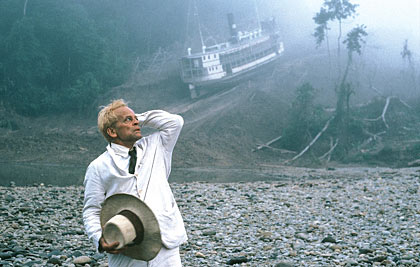
immature fan, I expected to see the kind of manic director that made Aguirre: the Wrath of God. In that film,
Herzog sticks with his lead character Don Lope de Aguirre as he leads his men
into the deadly interiors of the Amazon in search of El Dorado (a search that
is ultimately futile). One by one, his men are struck by arrows shot by Indian
tribes from ashore. The last to be struck is Aguirre’s own daughter, and she
falls limply into his arms and dies. He is the last one standing, and as he
surveys the scene of death around him, an army of monkeys climbs onto the raft,
claiming it for their own. Aguirre is deluded by now, but not enough to let go
of his savage ambition. “I am the wrath of God,” he declares to no one, staring
into the distance with mad eyes. He vows to find gold in El Dorado, and
recapture most of the lands of New Spain for himself, to rule like a king. “Who else is with me?” he
asks the dead and the monkeys. As the camera pans around the ruins on the
raft, we hear the music of
Aguirre by the band Popol Vuh, the same music that opens the film as the seekers
of El Dorado climb down a dangerous mountain. The music is hauntingly epic and
lamenting— it laments fallen heroes and the impending death of a dream. In Aguirre, there are many fallen heroes,
and Lope de Aguirre is one of them. In the first scene, the music eulogizes every
one of them. But in the last, it is played for Aguirre only— for what he is and
for what has become of him. It does not pity him, but rather it understands him
and feels sad. Again, Herzog speaks for
Aguirre through music, landscape and images of madness. It is very likely that he
sees something of himself in Aguirre’s irrational but dedicated drive, and so
the film is as much an introspective project as a work of fiction.
So why did I not
see Herzog the crazed director that evening at Amherst College? It was not just
because of the over-articulation in Into
the Abyss, but something about the lecture itself. It seemed that Herzog
had come here to give advice and not to converse. Instead of letting himself
unfold, he again articulated too much. It seemed like he was moderating his own
personality because someone had told him to be safe. However, the advice was
often beautiful, and there were three sentences that I will always remember:
1.
Psychoanalysis was the mistake of the 20th century
2. It is a
mistake to scrutinize the self
3. If your soul
is dark, let it be dark
Although these
three statements befit Herzog, it was difficult for me not to question them. Is
not what Herzog was doing in this lecture, and through the characters in his
films, a form of self-scrutiny? And does not this prove that it is an
unavoidable process for any artist, and perhaps not even a process they have
control over? What exactly did he mean when he said to allow the soul to “be
dark”? Incomprehensible darkness may make up most of the soul, and allowing it
to flourish produces many great things. But is not the basic function of
psychoanalysis to make us aware of
the dark parts of our soul, and not, as Herzog seemed to imply, to get rid of
them? And only once an artist becomes aware of or acknowledges the darker part
of his soul can he begin to articulate himself.
Everyone must
have darker shades in themselves that they cannot or choose not to explain, and
these are the parts we would call irrational. What makes artists act on their irrationality? Herzog is
also known to have eaten his own shoe, and plotted to kill his lead actor Klaus
Kinski, who plays the role of Aguirre (incidentally Kinski too hatched his own
plot to kill Herzog). Do even these irrational tendencies somehow make his
artistic personality more whole, or are they just the childish, self-indulgent
behavior of a man that believes he is entitled to it? It is too much to say
that as an artist, his irrational self is more powerful or extreme than a
regular person’s, or that it is in any way special. But perhaps his self-awareness,
or his compulsion to act and to make is stronger.
Burden of Dreams is about the making of Fitzcarraldo, another Herzog film about
a man driven by unreasonable desire. Fitzcarraldo wants to pull a boat overland
from one river of the Amazon to another, so that he can construct an opera
house on the other side. The project is threatened from the beginning. For the
shooting of the film, Herzog actually wants to perform this action of pulling a
boat overland— a stunt that apparently carries a 70% risk of causing casualties.
“I don’t want to live in a world where there are no lions or no people like
lions,” he says at one point.
Herzog knowingly
risks not only his own safety but also that of his crew, and he cannot quite explain
why. In apophthegm 154 in Beyond Good and
Evil, Friedrich Nietzsche writes, “everything absolute belongs to pathology”.
Nietzsche’s absolutes are “evasion” and “joyous distrust”— tendencies that make
a person go against norms. To embrace these tendencies is a sign of health—
bodily as much as mental health. A strong, powerful person will find that his
body and mind are in tune with a common urge— the urge to make, destroy and
digress. By becoming Fitzcarraldo and
filming against the wishes of nature, Herzog is putting himself to the test
physically as well as mentally, and he is willing to take himself to the
extreme. Irrationality is as much a bodily experience as an intellectual
one.
There are
irrational compulsions, inspiration, self-knowledge, and risk-taking, but to
produce a complete body of work, something has to bring these together, or it
would be too simple. For Nietzsche, sensuous experience could blossom into
intellectual activity, provided the person maintains a “cruelty of the
intellectual conscience and taste”. Then artistic conscience too must be
relentless and cruel so that it can acknowledge lack of knowledge, darkness and risk, to show what can be learnt
from these things, and ask even more questions. So the artistic conscience is
what stretches uncertainty to its limits to show what is beyond.
The second time
I heard Werner Herzog was at the Whitney museum in New York, where he spoke
more substantively about his own artistic process. He talked about the
importance of craftsmanship in every kind of creative activity, and the value
of study and technique. “I have always tried to decipher signs”, he told us. He
reads “signs” in music and painting and learns from them. Making movies allowed
him to learn from the world, putting together images, sounds and words. He may
not know why he chooses the stories that he does, and he cannot quite explain
much of his behavior as a director, but he knows for sure that his work is not
fruitless. He does not work to come to some sort of conclusion or find answers,
but to learn more and more about the possibilities of his craft— a process of
learning that is most probably infinite. For Nietzsche, a real artist must be
rigorously inquisitive, have complete faith to form, and pursue the
unintelligible without guilt.
However, like
the intellectual conscience, guilt too brings discipline to the spirit. Aguirre
and Fitcarraldo do not feel guilt and drive themselves to ruin, but Herzog
their creator does feel guilt. Maybe
he even feels guilty on their behalf. He eventually completes Fitzcarraldo, but his later words betray
something resembling guilt. Talking to Les Blank about the extent to which he
had taken himself and his crew, he says, “No one can convince me to be happy
about it when I am finished.” At most public appearances, he is a sort of role
model or example to emulate, and so he is probably required to present a nice,
easy version of himself. He must
not seem too crazed among impressionable young people or interviewees who help
keep him in the public eye. But more importantly, he talks to students, museum
visitors and documentary filmmakers because it forces him to keep evaluating
his work so that he knows where to take it next. It helps him to stay
productive.
So why did it
bother me that Herzog articulated too much in Into the Abyss, or advised too much at Amherst College? Possibly
because I didn’t want him to censor himself; I wanted to see a mad artist in
the flesh. But then I realized how childish this was. It is more likely that
his innate irrationality is deeper and more complicated— to the extent that it
affects the way he looks at life and his relationships with people. So I would
never see an artist’s madness so
easily in the space of two hours. To see Herzog ‘in the flesh’, I would have to
go back to his films, and I would find the irrationality in the faces, in the
landscapes and in the music. I would see the cruelty of his intellectual
conscience. But I will still never be able to separate the real man from the ‘nicer’
man, because maybe they need each other and so will co-exist, separately and
together.
Friday, July 6, 2012
Neverending Faces: A Brief Visit to La Plata, Argentina
© Shamoni Sarkar
Whoever thought
absence could have such a presence in so many different ways? “Absence” is a
word that Severo Sarduy uses repeatedly in La
Simulación, his collection of essays on metaphor. The absence that he
speaks of is the absence of a fixed essence, or a referent. He seems to be
saying that our world is filled with copies, representations and
re-representations that make us feel that we have lost track of their origins
(or our origins). Then he goes on to make an even stronger statement: There is no origin; there never was.
Thinking about
origins and absences reminded me of my day trip to the city of La Plata in
Argentina in October 2011. La Plata is a city that was built for a purpose. By
the late 1800s, Buenos Aires Province was expanding too quickly for the
government to control. Buenos Aires City was at the time both the provincial
and national capital, but this dual responsibility was gradually taking a toll
on the distribution of administrative duties. The governor Dardo Rocha founded
La Plata in 1882, naming it the new capital of Buenos Aires Province.
The city was one
of the first few in the world to be “rationally planned”. Unlike other cities,
it was not a space that grew and evolved organically. Instead, it was “built”
from scratch on a large plot of previously barren land. The dimensions of the
city were clearly mapped out. It was to be a uniform grid. Streets would not be
named but numbered (streets in Buenos Aires are named after generals,
politicians or other Latin American cities). There were to be small plazas with
“espacios verdes” (green spaces) every six blocks. One long diagonal would cut
across the city, while Street #32 would encircle it, forming its periphery. La
Plata is sometimes popularly referred to as “The City of Jules Verne”. Some
believe that its design was inspired by the utopian city France-Ville in
Verne’s 1879 novel The Begum’s Fortune.
In the story, public health and sanitation were priorities in the design of
France-Ville. Like France-Ville, La Plata was to be a truly modern city—
rationally ordered, clean, and existing for the good of the citizens only. The
term coined in the 19th century for this kind of engineering was
‘hygienism’.
Sarduy speaks of
the ideas of recreation and copy when he speaks of the Latin American Baroque.
For example, in the art of the Americas, he says, one sees an attempt to
assimilate the religious and mythological codes found in Spanish Renaissance
painting and reproduce it as something different— something that transgresses
the limits of the ‘original’. But the new work retains all the while evidence
of the intent— of the struggle to
break away. It retains the presence of what preceded it. Likewise, new urban
utopias (like La Plata) and the incorporation of rationality too are forms of a
Baroque ideal because they attempt to recreate. Although they do not seem to be
influenced by the old, as is the art that Sarduy speaks of earlier, they
nevertheless recreate themselves because they see the necessity to be something
new, unshackled from history. Sarduy’s assertion that neither originals nor
copies really exist seems strangely encouraging when seen in the context of the
Latin American city. But if there is no original, what do we have? Sarduy thinks that all we have is ambiguity, struggle and
incompletion. And he sees potential in incompletion— grey space for the
creation of new things.
But as I walked
down the streets of La Plata, the air felt different from the way it did in
Buenos Aires. Buenos Aires’s grandeur and rustiness were natural and palpable.
Remnants of Europe left in the architecture were given new life by the swagger
of the city around it. In La Plata, I felt like I was walking through a
slightly mythical space— space that existed in dimensions but whose physical
presence one could not feel. Someone told me that La Plata was constructed as a
city that did not change with the progression of time. Reading Sarduy on
absence reminded me of my visit to this city because it seemed ‘absent’ in both
space and time. But it wasn’t a sense of absence that pushed me away. Rather, I
felt the urge to take in more. There was
a sense there that could be touched and defined. I just had to come upon it
suddenly.
According to
Sarduy, portraiture and mimesis are ways for human beings to leave their
imprint on the world; in portraits people tend to leave signs of what makes
them human— dark eyes, the shape of the face, or ways of dressing. The canvas
not only immortalizes the human form, but also gives it wholeness and a truth.
But for Sarduy, the wholeness of form can never be reached. The only truth
exists in hints and fragments.
This idea that
wholeness can never be achieved, and that our repeated attempts to assert our
selves are futile made me wonder if the same could be said not just about Art
but about cities as well. I could now look back on La Plata in a different
light, and consider why I went there in the first place. One of the main
clandestine torture centers during the years of the dictatorship in Argentina
had been in this city. There is now a criminal court there that tries cases of
human rights violations that occurred during those years. On that particular
October day, I had gone to attend the witness testimony of María Isabel
Chorobik de Mariani, the founder of the organization Abuelas de Plaza de Mayo (Grandmothers
of Plaza de Mayo). It was the first testimony in a trial that was going to
last for the next several months. Mariani grew up in La Plata in a house of
musicians and architects (creative people were the preferred target of the
military, she told us). From the night of November 24th, 1976
onwards, she would go on to see the deaths of her son and daughter-in-law, and the disappearance of her granddaughter Clara Anahí. During the years that she
searched for her grandchild, she founded the organization to help other women
who were also searching for lost loved ones. She continues to search for Clara today. She put
whatever energy she had left into the running of her organization so that other
women could see that collectively, there was a way.
Strangely, I did
not note down the names of the ‘accused’ that she named in her testimony, nor
any other official details. I was too lost in the sound of the flow of her
words. For most of the time, I felt like I was watching the staging of a tragi-comedy.
Mariani had an extraordinary, matter-of-fact sense of humor, and it was as if
she felt entitled to use it after having gone through so much without humor. Also ironically funny
were the adolescent scribbles on the backs of the chairs that made everything
seem so trivial. One of them said ‘Blink
182’, bringing back my boy-band memories, and then I looked around and
realized that many others in the ‘audience’ were also part of the punk-rock
generation. For a few seconds, I even felt like none of us had any right to be
there. On the platform, I saw the 26 accused sitting on the far left,
well-dressed, with calm faces, as if they had long retired from ordinary jobs. None
of them stirred as Mariani narrated calmly the sequence of events of those
years. She had her back to them, but there was very little space between her
chair and their section of the platform. I was convinced that this part of the
room was filled with the most anger and violence. At one point, Mariani had to
pause after recounting to the jury (and to us) one of the more difficult parts
of her testimony. The audience, who had so far been hypnotized by her composure
and her incredible story, suddenly broke into applause, offering their
admiration and encouragement to keep going. The policemen lining the front
stirred, as if expecting us to start a riot. But calm ensued.
I had to leave
early to go back to Buenos Aires— back to the real world of classes and chaos.
We were once
told about the “logic of fear” adopted by the military government. I tried to
figure out what this could mean. Was it that the environment of fear was so
pervasive inside and outside the torture chambers that it had reached the point
that no other way of controlling things was possible anymore? Were torturer and
tortured locked in some kind of silent agreement that order would be maintained
only through fear and obedience? And was this why it was logical? However,
there was no logic in Mariani’s trial, but only a sense of theater, fragments
of history, and the slightly unbelievable physical presence of those involved
in that history. La Plata was a rational utopia that hosted an irrational,
non-utopian event. What did it mean hosting trials from such an important
period in history in La Plata in
particular? Was it not a way for people to leave an imprint of themselves in a
new space, to conserve traces of their history to give the new space a ‘truth’?
La Plata is the
true Baroque city— it searches for a truth through order and rationality.
Having a criminal court there is like painting a portrait of history, also to
immortalize a truth. But perhaps Sarduy would say that even then it is still
only constructed from diverse fragmentary representations from different times.
But I think La Plata does receive a
strange kind of wholeness by being so new while at the same time giving voice
to the old. However, it is a wholeness that is unstable and could break up into
fragments at any point. Despite this disconcerting sense, why did I still want
to go back? Was it a perverse wish to be caught between the perfect grid and
the imperfect history again? Or did I actually want to come away with something
concrete and good?
I wouldn’t know,
unless I went back.
Sunday, June 17, 2012
The Truth about Acting
© Shamoni Sarkar
The bright
red lipstick matches the red beret. The black leather jacket balances out the
redness and gives everything an air of casual coolness. I step out of the house
feeling like one of Woody Allen’s breezy new heroines.
Then
I see Cindy Sherman’s Untitled Film
Stills. Suddenly I am self-aware— aware of everything that goes on inside
my head as I put together my looks for different occasions. My look is done,
undone and redone, until it fits with a mood: relaxed, worried, thoughtful, or
Woody Allenesque. When the look complements the inner mood, I hear a voice of
approval, and then I’m ready to go. I construct little film stills of myself
ever so often. I am my own actress.
But what is the point of all this acting?
In Ingmar Bergman’s Scenes from a
Marriage, Liv Ullman’s character Marianne reads aloud to her husband Johan
from her diary. She has written of a childhood spent on being pleasing and
obedient to her parents, but completely ignorant of who she was or what to make
of her own life. The greatest deception, she writes, came at puberty, when her
mind was flooded with thoughts of sex and secret wishes to become an actress.
At her father’s insistence she finally became a lawyer, but, like everything
else she had done in her life, her lawyer self was also an act. Even in her
relationships with men, she invented herself, because she did not know what to
present to them otherwise. When she finishes reading the entry she looks over
at Johan, only to find him fast asleep on their couch. If acting is a lie, then
Marianne has been lying her whole life. Now, when she finally reveals the truth
about her lies, there is no one awake to acknowledge her.
Sherman’s film stills are
also all about acting: trial runs, dressing up and recreating oneself. But,
like Marianne in Scenes from a Marriage,
she uses acting to get at a truth (or many truths). At first though, the film
stills are deceptive. Each of them reveals itself to us at two levels: as a
photograph and as cinema. As a photograph, each film still has a mood. Untitled 56 (1980) evokes “icy” or “cold contemplation”.
The woman looks into the mirror, and her reflection looks back at us. We want
to know what she is thinking, and whether she is using the mirror to validate
her thoughts. But it is Sherman
framing herself and posing for us. It is Sherman
acting the part of a cold, contemplative woman. She has created everything that makes the photograph. But then what
is true about it? Is she not doing
exactly what Marianne says she has been doing her entire life— playing roles
and acting?
At this point of
doubt, the photograph becomes cinema by taking on a story. This woman could be plotting murder! I am reminded of the icy blonde
heroines in Alfred Hitchcock movies. The Sherman of Untitled 56 could very possibly be a version of a Hitchcockian
heroine— she is beautiful, someone who always gets what she wants, but who is generally
unpopular and is about to unwittingly fall into a bad situation.
Almost all the film
stills have elements running through them that we have learned to read from the
cinema. They all have pointers that originate in fiction. For example, there
are waiting women such as in Untitled 50
(1979) and Untitled 15 (1978). We
also recognize and articulate that they are different kinds of waiting. The
waiting woman in Untitled 50 seems
wealthy but lonely. We assume that she is waiting for an uncaring husband to
come home. But she seems disinterested and bored as well, waiting only because
there is nothing better to do. In Untitled
15, the high heels, the short dress and the necklace with a cross all
suggest a young small-town girl that has come to the city to chase her dreams.
As she looks down from her window, she could be looking out for a man, for a
friend or just for the dreams that she came to follow. There are many other pointers
in the film stills, both concrete and suggestive. Though they exist in real
life, we learn to identify them on screen. One notes short black hair, bonnets,
staircases from which women look down or up, and shadows. They give the story
to the initial mood set up in the photograph, turning it into cinema.
When we see the film still as a whole, i.e. as one-dimensional mood and
cinema coming together, we realize that we cannot really separate the camera
from life, or acting from truth. We associate Sherman’s film stills with other
filmic moments we have seen and probably did not even consciously remember. The
cinema seems to be our only filter. In fact, even if we were not told that they
were “film stills”, we would still associate them with cinematic images.
But then is
the mood fictional as well? Don’t we at least know, from our own lives, about
the pain of waiting or the discomfort of coldness? And don’t we then make
cinema by giving stories to these vague, but true, moods? So in a way, isn’t it
all true, including the cinema? And so it would seem that Sherman is getting at the truth, or rather a truth, in each film still.
This still does
not answer the question of why we
dress up, or imagine ourselves in a certain way. Why do we want to dress up our
moods? The search for a truth does not seem like a plausible reason because we
cannot explain why we lie (or act) to get to it. We do not know why Marianne
would need to write in her diary about her life of acting, or even why she
would want to read it out to Johan. The only way she is able to get at her
truth is by admitting that she has been acting. But does this revelation mean
that she has stopped acting? And if
she has not stopped acting, she has not been able to find that elusive truth.
In an interview with New York Magazine, Cindy Sherman says that she wanted to
“try on” all her film still roles. She herself is unsure about why she did
them, but she wonders if maybe she actually did
want to be her characters and not be herself. However, she also says that she
was uncomfortable with the idea of going to work dressed like her characters,
because she felt she wouldn’t be wearing her “normal armor”. “Normal” suggests
that there is a real Cindy Sherman,
but “armor” once again suggests dressing up. Perhaps there is a certain Cindy
Sherman she is most comfortable being, if she were to choose among all the
other possible Cindy Shermans. And maybe this is the self she wears when she is
not dressing herself up for her art.
If one looks at
Untitled 56 again, one notices the
way the side of Sherman’s face is framed, as if she handled the light in such a
way that it looks like a part of her hair. But of course it isn’t, because one
can see through its transparency to the way her hair actually curls, away from
her face. And then, one notices the circular black object near her chin, which
looks like a flashlight. Perhaps the light from that, and the natural light
from the sun (which illuminates a part of the hair) create the effect that we
see. But one can only guess. What is clear, though, is that Sherman has
‘played’ with the photograph. She starts from a truth, whether it is a mood, or
a certain mannerism, gives it a story, and then turns it into something
completely different in the photograph, by introducing something unnatural into
it. But there is always a truth in them, or in her, which never gets lost. This is why she is able to keep working
and changing roles, without letting go of her mysterious core. Similarly, there
is something true about Marianne (a certain way of being perhaps) that she must
have recognized in herself, or else she would not have been able to admit that
she had been acting.
Maybe the answer is that we want to know all of our possibilities, and
so we allow life and screen to overlap, sometimes to the extent that we cannot
differentiate between them. We want to know how we can dress up our truths
because we do not want to remain static. But even if we resign ourselves to
this answer, questions still remain. Do we really have a truth to dress up? If
so, could it ever be lost under the layers of costume?
Thursday, June 7, 2012
Madness and Yearning in Cindy Sherman and Pina Bausch
© Shamoni Sarkar
All you can do is hint at things
Pina Bausch
If an
artist’s “hint” is powerful enough, the audience, the art and the artist
herself are embraced in a common relationship of madness. Speaking of photography
in his book Camera Lucida, Roland
Barthes describes this maddening process: “it bears the effigy to that crazy
point where affect (love, compassion, grief, enthusiasm, desire) is a guarantee
of Being. It then approaches, to all intents, madness” (Barthes, 1981). Barthes
says that photography is “mad” because it shows more than it tells. It traps a
real moment in time, so in a way it captures a truth, but we can know nothing
more of this truth except for the fact that it happened. So if we happened to see, for example, a photograph of a
young girl holding an ice cream, but with tears running down her face, we would
not be completely satisfied simply by seeing a touching photograph. We would
want more to complete our story and answer questions such as “Why is the girl
crying when she has what any child would want?” or “Who is this child?” We would want to have a concrete detail to hold on
to, to pin down our brief relationship with the picture. Barthes seems to be
saying that we want to experience our own “affect” instead of looking from a
distance at another’s. So in a way the photograph cheats us by not giving us
everything. It is a work of art in limbo, and this is why it is “mad”.
The
art of Pina Bausch and Cindy Sherman is mad in a Barthesian way because it feeds
on affects, especially desire and yearning, to bring out its reality. It is the
madness of Bausch’s work that Wim Wenders pays tribute to in his documentary Pina. In
an interview, he says that the only way he thought he could do justice to
her was by making the film in 3D. He does not explicitly say why, but perhaps
he saw the importance of making the audience feel the madness of her choreographies at more than just the visual
level. In fact, the effect of madness in both Sherman and Bausch’s works is
doubled because not only are the works
themselves “mad”, but the subjects represented in the works too seem mad. Madness
is a more exclusive state of being than the state of feeling desire or longing.
So viewers may feel that they are denied any
understanding of what the subjects themselves are going through. They are
denied, as Barthes calls it, the guarantee of the subject’s Being. Angered, a viewer
may even question Sherman and Bausch’s motives. Do Bausch and Sherman even know
what madness is? If not, how can they attempt to depict it to ignorant viewers?
Are they taking advantage of their mad mediums?
But
are they consciously depicting madness,
or are they just hinting at unnameable things? In Cafe Müller,
the madness is all in Pina’s body: her skeletal figure enters wearing a white
nightgown, arms stiff and outstretched with palms facing outward, and eyes
closed. For the next forty-nine minutes, she flails purposelessly, despairs
silently and gets trapped in the circular motion of the revolving door. She
strays away, but always comes back to the same position, and always uses the
same wall as support. The initial hint is the entry. It is strong enough, and
is used repeatedly throughout the piece to tell us that this woman is lost to
herself, sad, desperate, and perhaps blind. She should feel lost to us as well,
but yet she does not.
Igor
Stravinsky composed the ballet Le Sacre
du Printemps inspired by the story of the Russian pagan ritual of the
self-sacrifice of a young girl to the God of Spring. Bausch’s choreography of
it takes it beyond the simple plot and fills it with innumerable possibilities
of meaning. One may think of coffee plantations, a violent rape or the loss of
protection. Again, all that we have are hints: the bare setting strewn with something
that resembles mud, the red dress that replaces the white after the girl has
been “chosen” by the man, and the desperate, throbbing circle of bodies that
the women form when they are threatened. The bodies of both the men and the
women convey anger, power, necessity and desire in every collective gesture,
whether they lunge forward at each other or contract their arms and fists,
resisting. As they dance and move, their faces always look mad, but it is an
internal, undirected madness. We do not know where so much feeling comes from,
but we can still see it unfolding before us. “Where does all the yearning come
from?” Bausch is quoted as having asked one of her dancers. Perhaps she worked
only to answer this question, and found that she could only hint at the answer.
In Sherman’s Untitled 122 (1983),
the body of the woman photographed also hints at her madness in very similar
ways: stiff, straight arms, a thin body wearing clothing that is more
protective than attractive or comfortable, and clenched fists. Her eyes are
open, but mostly covered by her unruly hair— another hint.
Bausch and Sherman hint at things we have already learned to associate with madness: desperation, loneliness, gestures, and challenged femininity. But once we separate these qualities from the idea of madness, we realize that we have seen or known them in our own lives. We have known desperation and loneliness, and perhaps sometimes we have even felt as if our identities have disintegrated and we have been left with nothing. We have all been mad before, and we are able to see hints of our own madness in dance or in pictures. Madness is grief and desire, and understanding this much is enough, for the artist as well as the beholder.
In Untitled 92 (1981), desire and madness are entwined to the extent
that they seem perverse. The information on the wall tells us that the series
of photographs in that particular room were modeled on pictures in men’s erotic
magazines. Our eyes are drawn to the checked skirt resembling a school uniform,
the way the girl poses on her hands and knees, and the ambiguous blue eyes. But
her eyes do not look submissive, nor do they have the devouring stare of
invitation that one normally sees in models in erotic magazines. In their
unknowable blueness there is a hint of fear but an even larger hint of madness.
The blueness of the eyes captures the blue lighting of the photograph and the
blueness of the skirt, as if the madness of the entire photograph converges in
them. The madness is adult and a startling contrast to the girl’s schoolgirl
demeanor. Desire is engineered in this photograph: We imagine a man watching and wanting the girl, and the girl looking
back at us and at him, conscious of being looked at. But unlike in Bausch’s
work, there are no real feelings conjured
by the photograph for us to identify with, so we can only be perplexed, and
perhaps discomforted, by its madness. What draws us to the kind of madness in
this photograph? What guarantees its Being?
Barthes likens photography to a “science of desirable and detestable
bodies” (in reference to the entire body of the photograph and not just the
individual bodies portrayed in them). Cafe
Müller is filled with darkness but we feel the warmth, or rather the
consolation of it because we can somehow identify with what is being hinted at.
We desire the body in Cafe Müller
more. Sherman’s Untitled 92 is cold
but we do not turn away from it. But do we detest it? Perhaps some would object
to the suggestion of a child in the photograph, or to the uncomfortable
position Sherman puts them in as viewers. But the most detestable thing about
the picture is probably that we do not understand the truth contained in the
blue eyes. We go back to madness— a madness that we cannot feel. But whether
comprehensible or not, Barthes appeals to us to protect Madness and to save
Desire to truly experience what a photograph can give us. “You just have to get
crazier,” Bausch tells one of her disillusioned dancers. Both she and Sherman
invite us to fall deeper into madness and desire instead of distancing
ourselves from them. It is an invitation to go beyond incomplete understanding
and lose oneself in one’s own mad feelings.
Subscribe to:
Posts (Atom)